

T: +86-571-87819638
P: +86-138-19484466
E: overseas@cnjinling.com
E: overseas@cnjinling.com
No. 38, JieFang East Road, DianKou Town, ZhuJi City, Zhejiang Province, China
Views: 0 Author: Site Editor Publish Time: 2026-03-06 Origin: Site


Efficient cooling is a cornerstone of modern industrial processes and facility management. In facilities ranging from large-scale HVAC systems to industrial manufacturing plants, maintaining optimal temperature levels is crucial not only for operational efficiency but also for extending the lifespan of equipment. Overheating can lead to increased energy consumption, reduced equipment efficiency, and even unplanned downtime, all of which can have significant financial implications.
Among the many solutions available, the Cross Flow Closed Cooling Tower has emerged as one of the most reliable and efficient technologies in industrial cooling. Unlike open cooling systems, which expose process water directly to ambient air, cross flow closed cooling towers employ a closed-loop design, ensuring that the cooling medium remains isolated from external contaminants while achieving optimal heat transfer.
A Cross Flow Closed Cooling Tower combines innovative design, advanced materials, and precise airflow management to provide consistent thermal performance. By selecting the right cooling tower for your facility, you can achieve energy efficiency, reduce water treatment costs, and extend the operational life of the system. This article explores everything facility managers need to know when selecting a Cross Flow Closed Cooling Tower, including design principles, key features, material options, and operational considerations.
A Cross Flow Closed Cooling Tower is a cooling solution where hot process water or other heat-transfer fluids circulate through a series of closed-loop coils, while ambient air flows horizontally across the coils. This configuration allows maximum surface contact between air and the coil surfaces, facilitating efficient heat exchange.
The cross flow design has several unique components:
Coils or tubes that carry the process fluid in a sealed environment, preventing contamination from dust, debris, or biological growth.
Air intake louvers on the sides of the tower, which guide the airflow across the coils for uniform heat transfer.
Spray or distribution systems that evenly distribute water over the coils to enhance evaporative cooling effects.
This combination ensures that the heat from the process water is efficiently transferred to the ambient air, while the process fluid remains uncontaminated and protected from environmental factors such as pollutants, UV exposure, and debris.
The cross flow configuration offers several operational and engineering benefits:
Enhanced heat transfer efficiency: The perpendicular arrangement of air and water flow maximizes contact and allows for uniform cooling across all coils.
Reduced maintenance complexity: Components like coils and spray systems are easily accessible, allowing for quicker inspection and preventive maintenance.
Scalable and modular construction: This design enables the tower to be configured in multiple sizes or connected modules, making it adaptable for facilities with space or capacity constraints.
Furthermore, cross flow towers provide more uniform water temperatures exiting the system compared to counterflow designs, making them preferable for precise industrial processes.
Unlike open cooling towers, where process water is exposed directly to air, a closed-loop system maintains water within sealed coils, separating it from environmental contaminants. Advantages include:
Prevention of contamination: The fluid remains protected, avoiding microbial growth, sediment accumulation, or chemical contamination.
Reduced water treatment needs: Lower exposure to environmental factors reduces the need for chemical treatment and regular water quality interventions.
Lower corrosion and scaling risks: Since the process water is isolated, scaling, rusting, and sediment buildup are significantly minimized, improving coil longevity and overall system efficiency.
The closed-loop design ensures a more predictable, reliable cooling performance, making it especially beneficial in facilities with sensitive process fluids or strict regulatory requirements.
Selecting the right Cross Flow Closed Cooling Tower involves evaluating several critical features, each impacting long-term performance, maintenance, and energy efficiency.
Heat exchange efficiency is the cornerstone of cooling tower performance. Factors that directly influence efficiency include:
Coil material: Stainless steel and copper provide superior thermal conductivity, reducing the temperature of process water more effectively.
Finned coil designs: Fins increase the effective surface area, enhancing heat dissipation and reducing the approach temperature.
Airflow uniformity: Optimized louver and fan design ensures consistent air distribution across all coils, preventing hotspots and maximizing performance.
Investing in towers with high heat exchange efficiency can reduce energy consumption, improve temperature control precision, and lower operational costs over the tower’s lifespan.
The closed-loop system provides numerous advantages beyond simple contamination prevention:
Protects sensitive process fluids: Critical industrial fluids, such as deionized water or glycol mixtures, remain uncontaminated.
Reduces operational downtime: Less frequent cleaning and water treatment translate into more continuous system operation.
Energy and resource savings: Minimizing water loss and chemical treatment needs directly reduces facility operating costs.
Improved regulatory compliance: Many industries require strict fluid quality standards; closed-loop systems simplify adherence to these regulations.
A properly designed closed-loop system ensures long-term performance consistency, which is vital for facilities with continuous operation requirements.
Modern Cross Flow Closed Cooling Towers incorporate several design features for operational efficiency:
Modular construction: Simplifies transportation and installation, particularly for large-scale facilities.
Large inspection doors: Facilitate routine maintenance, coil cleaning, and component inspection.
Operational monitoring: Allows staff to observe fan performance, water distribution, and airflow while the system is running, ensuring issues are identified and addressed in real-time.
Noise reduction designs: Many cross flow towers integrate acoustic dampening features to minimize operational noise without compromising airflow.
These features improve system reliability, simplify maintenance, and enhance overall safety during operation.
Selecting appropriate materials ensures both durability and thermal efficiency:
Component | Standard Material | Optional Material | Benefits of Optional Material |
Coils | Stainless Steel 304 | Copper | Higher thermal conductivity, improved heat transfer |
Tower Body | Galvanized Steel | Stainless Steel 304 | Enhanced corrosion resistance, longer service life |
Fan & Motor Housing | Aluminum or Steel | Optional Coating | Corrosion resistance in humid or coastal environments |
Nozzles & Piping | PVC or Standard Steel | Stainless Steel or Brass | Durability, reduced scaling, better chemical resistance |
Upgrading materials, particularly for critical components, can significantly improve operational longevity, reduce maintenance requirements, and increase overall energy efficiency.
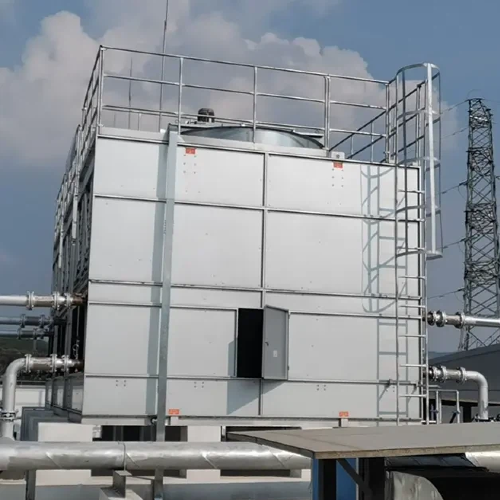
The versatility of Cross Flow Closed Cooling Towers allows them to be applied across diverse industrial environments:
HVAC systems in commercial buildings: Provides efficient temperature control while keeping water free from contaminants.
Chemical and pharmaceutical processing: Maintains fluid purity and consistent cooling, essential for sensitive operations.
Food and beverage production: Prevents contamination and preserves compliance with hygiene standards.
Energy generation and industrial plants: Provides high-efficiency cooling for turbines, compressors, and other critical equipment, improving reliability and reducing energy consumption.
These towers are suitable for any facility requiring precise temperature control, clean fluid circulation, and long-term operational reliability.
Choosing the optimal Cross Flow Closed Cooling Tower requires evaluating several facility-specific factors:
Cooling Capacity: Determine the total heat load and ensure the tower can handle peak operational demand.
Site Constraints: Assess footprint, height restrictions, and access points for installation and maintenance.
Airflow and Fan Selection: Fans should provide even distribution, low noise, and energy-efficient operation.
Water Distribution System: Verify that spray nozzles and piping ensure uniform water flow across coils.
Energy Efficiency and Sustainability: Towers with variable speed fans, optimized coil surface design, and low approach temperatures help reduce operational energy costs.
Careful assessment of these factors ensures the selected tower meets operational requirements while maximizing energy efficiency and reliability.
Regular maintenance is essential to sustain the performance of Cross Flow Closed Cooling Towers:
Routine inspections: Evaluate coil conditions, fans, spray nozzles, and structural integrity.
Periodic cleaning: Prevent buildup of scale, sediment, or algae, which can reduce efficiency.
Accessible components: Towers with large inspection doors and modular designs simplify maintenance tasks.
Long-term monitoring: Tracking system performance over time allows preemptive adjustments, maintaining energy efficiency and extending lifespan.
A well-maintained tower not only sustains cooling performance but also reduces unexpected downtime, minimizes repair costs, and prolongs the service life of critical components.
Selecting the right Cross Flow Closed Cooling Tower is a critical decision for facility managers aiming for reliable, efficient, and low-maintenance cooling solutions. By prioritizing heat exchange efficiency, closed-loop protection, high-quality materials, and advanced operational features, we can ensure consistent cooling performance, reduce maintenance frequency, achieve energy savings, and safeguard critical process fluids. The versatility of Cross Flow Closed Cooling Towers across industrial sectors makes them an indispensable component of modern cooling infrastructure. To explore tailored solutions, optimize system performance, and learn more about the benefits of these towers, we encourage reaching out to Zhejiang Jinling Refrigeration Engineering Co., Ltd., where our team can provide expert guidance and personalized recommendations to meet your facility’s unique cooling requirements.
1. What is a Cross Flow Closed Cooling Tower?
A cooling tower where process water flows through sealed coils while ambient air flows perpendicularly across the coils, enhancing heat transfer while keeping the fluid clean.
2. Why choose a cross flow design over other cooling towers?
Cross flow designs offer improved thermal efficiency, easier maintenance, and consistent performance across various operational conditions.
3. What industries benefit most from cross flow closed cooling towers?
HVAC, chemical, pharmaceutical, food and beverage, and energy generation sectors benefit most due to fluid purity and reliable cooling requirements.
4. Can the materials be customized for specific operational needs?
Yes, coils, tower bodies, fans, and nozzles can use stainless steel, copper, or coated materials for enhanced performance, durability, and corrosion resistance.
5. How does the closed-loop system affect maintenance?
It reduces contamination risks, decreases water treatment requirements, and allows for easier cleaning and inspection.
6. How do I determine the right model for my facility?
Consider cooling capacity, space constraints, airflow efficiency, water distribution uniformity, and energy performance requirements.
7. What factors contribute to long-term efficiency?
Regular inspections, proper cleaning, accessible components, and monitoring system performance ensure sustainable energy efficiency and operational reliability.


